
Call for Papers
Important Dates
Abstract / Full Paper Submission
Publication Opportunities
Conference Fee
Conference Main Topics
Review Process
Paper Template
Book of Abstract
Book of Proccedings
Keynote speakers
Honorary committee
International Scientific Committee
Organizing commitee
Agenda
Contact Us
Call for Papers
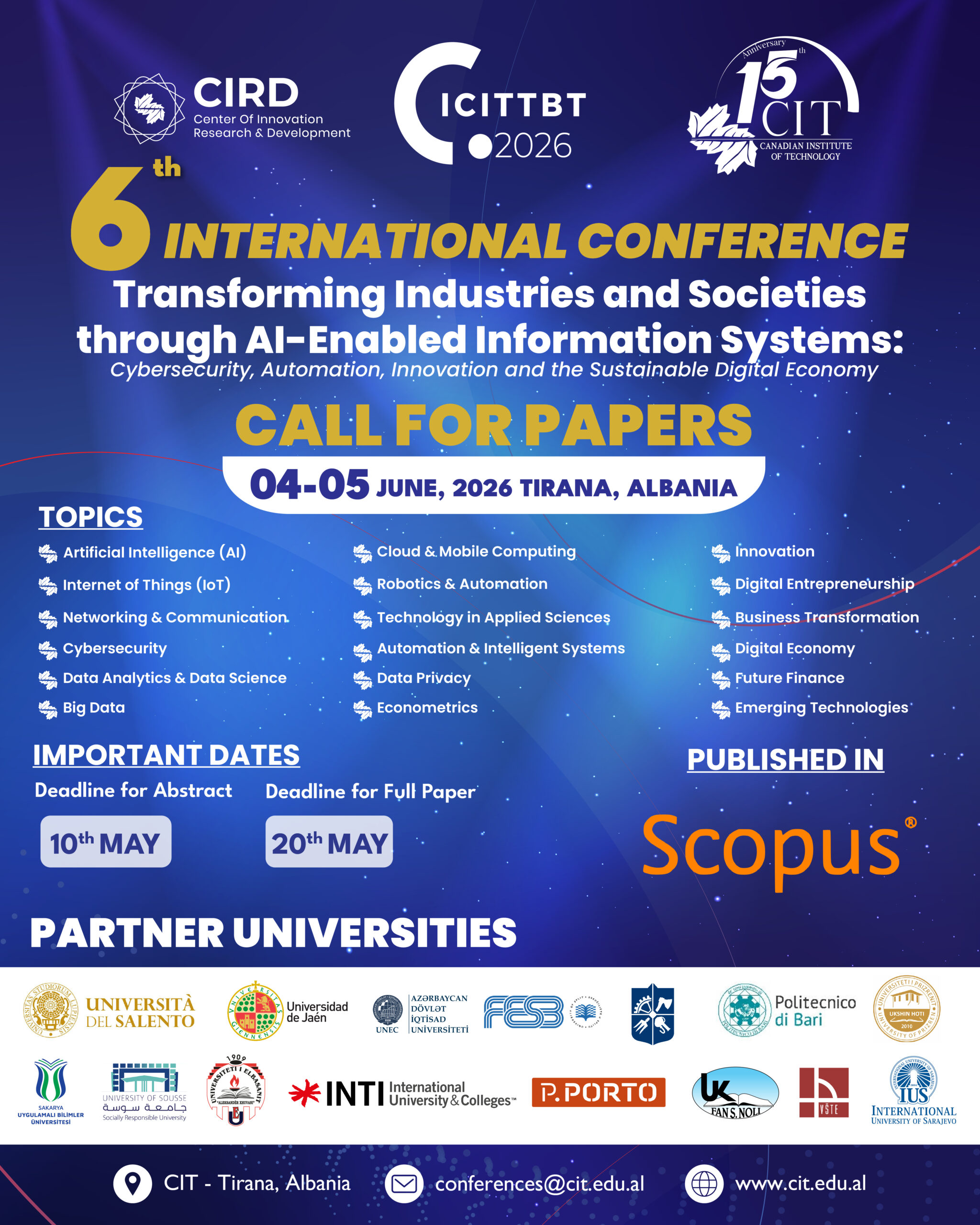
Transforming Industries and Societies through AI-Enabled Information Systems:
Cybersecurity, Automation, Innovation and the Sustainable Digital Economy
Purpose of the Conference
CIT is proud to celebrate the 15th anniversary of its foundation. Over these years, CIT has successfully hosted numerous international projects and scientific conferences, contributing significantly to knowledge exchange and innovation.
In today’s world, an AI-powered life is no longer a vision—it is our reality. In this context, CIT, on the occasion of its milestone anniversary, invites scholars, innovators, and policymakers from around the globe to engage in the 6th International Conference of CIT which aims to facilitate the exchange of ideas, research, and practical advancements that drive transformation in industries and societies through AI and related technologies. A unique forum where universities lead the dialogue on the impact of AI-driven innovation on AI, cybersecurity, automation, robotics, economic development, workforce transformation, digital trade, governance, and ethical considerations.
No doubt, the whole World is affected by the new technological changes. This transformation affects industries and societies directly!
By bringing together researchers, practitioners, and industry experts, this international conference aims to explore effective collaboration between academia, industry, and policymakers, with the goal of enhancing productivity, supporting informed decision-making, and fostering sustainable solutions across diverse sectors. Furthermore, the conferences aims to address the growing cybersecurity challenges accompanying AI-driven transformation; finally the conference has its purpose to encourage interdisciplinary collaboration to generate new ideas, accelerate technological breakthroughs, and support the development of next-generation digital solutions as well as explore advancements in automation, including robotics, intelligent systems, and smart infrastructure, and their potential to enhance efficiency, reduce errors, and optimize industrial processes.
Authors, worldwide, will lead the conversation on creating a trusted and sustainable digital economy for future generations.
All accepted papers will be included in the Springer Proceeding Book , published by CIT and CRJ journal of CIT, further disseminating cutting-edge research to the global scientific community.
Important Dates
| SUBJECT | DEADLINES |
|---|---|
| Deadline for Abstract Submission* | 10th May, 2026 |
| Deadline for Full Paper Submission | 20th May, 2026 |
| Authors Notification | 25th May, 2026 |
| Author Registration | 30th May, 2026 |
| Final Manuscript | 30th May, 2026 |
* The required Abstract Format can be found in the “Paper Template”
Abstract / Full Paper Submission
Email your Abstract / Full Paper to:
[email protected]
Publication Opportunities
All accepted and presented papers will be published according to the authors’ choice in one of the following outlets:
CIT – Conference Book of Proceedings
CRJ Journal | Peer-Review: crj.cit.edu.al
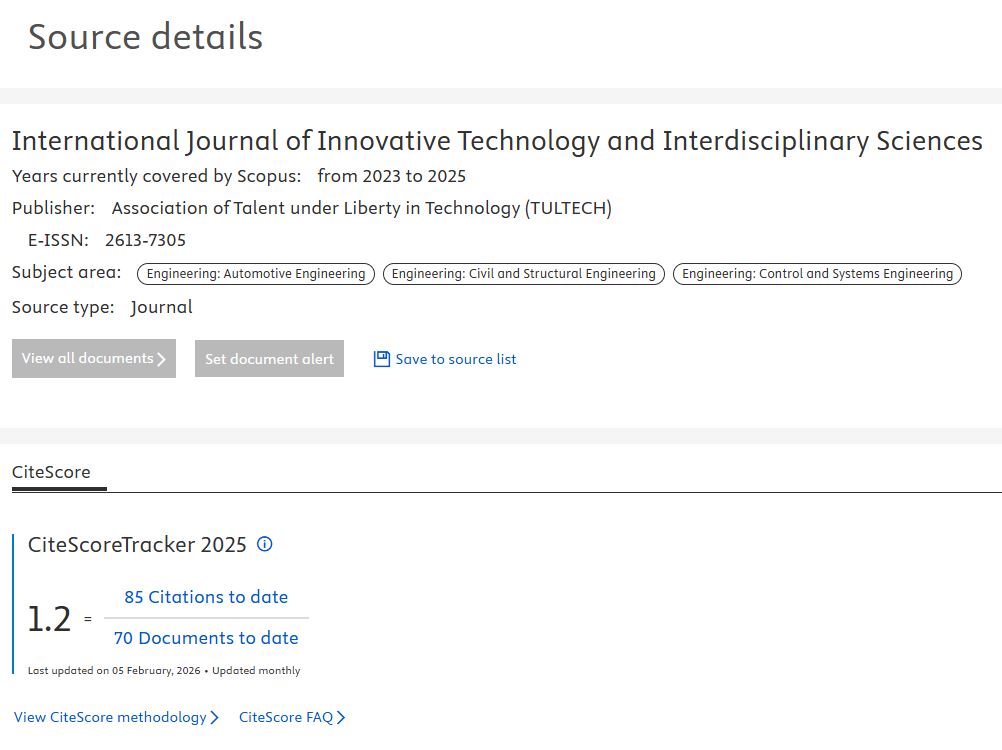
- IJITIS – International Journal of Innovative Technology and Interdisciplinary Sciences – SCOPUS Indexed www.ijitis.org
CRJ Journal: Upon the request of the Authors, the Selected papers of the 6th ICITTBT 2026 Conference will be published in the CIT Review Journal (CRJ), an international, peer-reviewed, open access journal (free for readers) that serves as a platform for publishing original research in the fields of Economics, Business, and Information Technology.
IJITIS: The journal, E-ISSN : 2163-7305, is indexed in SCOPUS (Scopus CiteScore = 1.2)
Conference Fee
“`html
| CONFERENCE REGISTRATION TYPES | ||||
| Description | Participation Benefits | Details |
Fees (Euros) |
|
| All accepted papers and presented in conference will be submitted for Springer Series indexed in Scopus. |
Proceedings Book Paper Author |
Proceedings Book Scopus-indexed (Online Publication); Certificates of Presentation for the presenter and other authors; Conference Materials; Attendee ID Badge; Network Lunch; Cocktail; Gala Dinner; |
Proceedings Book – Scopus-indexed | 400 |
| Extended version of accepted papers in Conference will be published as special issue at IJITS journal indexed in Scopus | Paper Author |
IJITS: The journal, E-ISSN: 2163-7305, indexed in SCOPUS (Scopus CiteScore = 1.2) |
Scopus Index | 400 |
| For participants that request only the Book of Abstracts | Abstract Author |
CIT Online Book of Abstracts; Certificates of Presentation for the presenter and other author; Conference Materials; Attendee ID Badge; Cocktail; Gala Dinner; |
€70 | |
| Info. | Additional Author |
The accompanying person fee (if they participate in the event) |
€30 | |
| For Non-Authors | Non-Author |
Participation and Network; Conference Materials; Attendee ID Badge; Cocktail |
€20 | |
* Springer Book Series Publication Deadline – June 30, 2026
Bank Details:
Bank Details: CREDINS BANK sh.a.,
SWIFT Code: CDISALTRXXX
Account Holder: C.I.T SH.P.K
Account Number: 00001428565
Currency: EUR
IBAN: AL71 2121 1009 0000 0000 0142 8565
Conference Main Topics
- Intelligent Information Systems and AI-Driven Decision Support
- AI for Business Intelligence and Decision Support
- Machine Learning for Enterprise Systems
- Generative AI in Knowledge Management
- AI in Healthcare & Education Information Systems
- AI for Economic Forecasting & Policy Modeling
- Responsible AI Governance
- Data Science, Big Data and Policy Intelligence Systems
- Big Data Platforms for Organizational Analytics
- Predictive & Prescriptive Analytics
- NLP & Computer Vision in Information Systems
- AI-Enhanced Econometric Modeling
- Data-Driven Policy & Economic Intelligence
- Ethical Data Governance
- IoT, Smart Infrastructure and Secure Digital Ecosystems
- IoT Architectures for Smart Systems
- Edge/Fog Computing
- Smart Cities & Connected Platforms
- 5G/6G Enterprise Communication Systems
- Blockchain for Secure Data Exchange
- Cybersecurity in Critical Infrastructure
- Cloud-Based and Distributed Enterprise Information Systems
- Zero-Trust Architectures
- Hybrid & Multi-Cloud Systems
- Cloud-Native AI Platforms
- Mobile Information Systems
- Green Cloud Computing
- Automation, Robotics and Intelligent Process Systems
- RPA in Business Process Management
- Intelligent Automation in Organizations
- Human–Robot Interaction
- Autonomous & Assistive Systems
- AI-Driven Control Systems
- Cybersecurity Governance, Privacy and Digital Trust
- Privacy-Preserving Information Systems
- Fraud Detection in Public Sector
- Regulatory & Compliance Frameworks
- Digital Government Security
- Digital Trust & Child Online Protection
- Digital Innovation, Entrepreneurship and Information Systems Management
- Digital Business Models
- IS-Driven Entrepreneurship
- Organizational Change & Transformation
- Enterprise Strategy & Digital Governance
- Innovation Ecosystems
- Sustainable Digital Economy and Financial Information Systems
- Digital Banking & FinTech Platforms
- Green Finance Systems
- Fiscal Risk Modeling & Public Finance Analytics
- Digital Inclusion & Skills
- Sustainable & Inclusive Digital Development
Review Process
The review process will be double-blind. Each paper will be reviewed by at least two members of scientific committee. The acceptance decisions will take into account paper novelty, technical depth, elegance, practical or theoretic impact, and presentation.
- Original: the paper explores a new idea, project or issue; discusses existing research with promise of new insight, discusses new research; or presents new ways of considering existing information
- Engaging: presentation format will involve the audience in some way, or has high potential to attract conference attendees by addressing needs of the community
- Significant: the paper raises and discusses issues important to improving the effectiveness and/or sustainability of open education efforts, and its contents can be broadly disseminated and understood
- Quality: claims are supported by sufficient data; claims draw upon relevant literature; and limitations are described honestly
- Relevant: the paper addresses one or more of the themes of the conference
Paper Template
Book of Abstract
Book of Proccedings
Book of Proceedings of International Conference
| Volume 1 | — |
| Volume 2 | — |
Keynote speakers
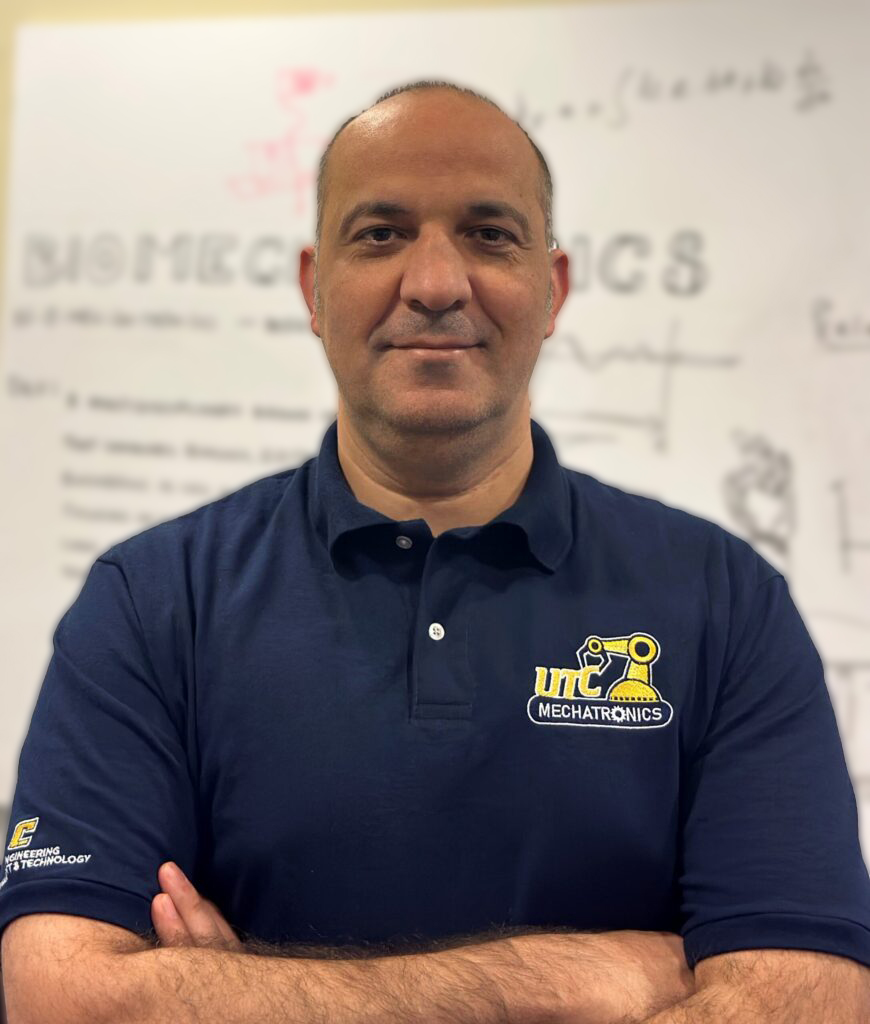
Prof. Erkan Kaplanoglu
Topic: “Biomechatronics in the AI Era: Transforming Healthcare and Human Performance”
Prof. Kaplanoglu is a Professor in the Engineering Management & Technology Department, Mechatronics at the University of Tennessee at Chattanooga (UTC). He received a bachelor’s degree from Marmara University Electric Edu Department, in 1996. He completed his M.Sc. and Ph.D. thesis at the Computer-Control Department of Marmara University, Institute for Graduate Studies in Pure and Applied Sciences, in 2000 and 2006, respectively. He worked as a visiting research assistant professor at the Department of Mechanical Eng. Vanderbilt University Faculty of Engineering from 2011 to 2012. In 2019, He founded the Biomechatronics & Assistive Technology Lab (BioAstLab). The establishment of this lab has led to collaborations with the departments of biomedical and medical at other partner higher education institutions. His current research focuses on Biomechatronics Systems; EMG and EEG controlled Prosthesis/Orthosis and Wearable Rehabilitation Robotics. He serves as an Associate Editor for the IEEE Transactions on Neural Systems & Rehabilitation Engineering.
Prof. Daniel Remondini
Topic: “The power of Protein Language Models in biomedical applications”
Prof. Remondini is a Full Professor of Physics at the University of Bologna, Italy, since 2019. He earned his degree and Ph.D. in Physics from the same university, with early research on neural networks and synaptic plasticity. His work lies at the intersection of physics, biology, and data science, focusing on bioinformatics and high-throughput “omics” data analysis. He develops and applies methods based on Network Theory, Machine Learning, and Artificial Intelligence to complex biological and biomedical data, including imaging and next-generation sequencing. He has authored over 170 peer-reviewed publications and has received more than 4,000 citations, with an h-index of 35 (Scopus).
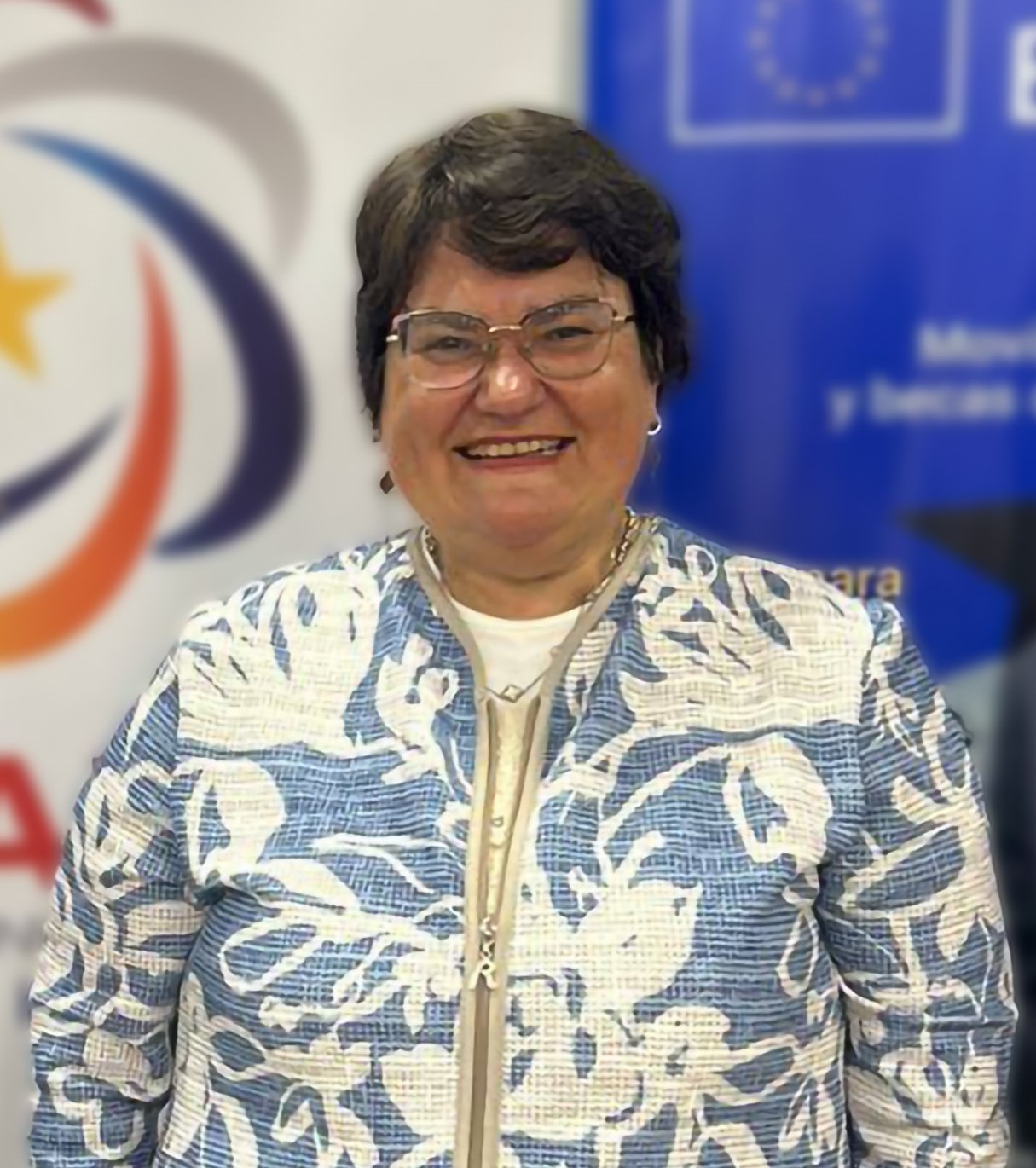
Prof. Galia Marinova
Topic: “Advanced AI-assisted Computer-aided Design and Management Platforms”
Prof. Marinova graduated as engineer with Master degree in electronics in 1988 in Technical University-Sofia. She received a Ph.D. degree in 1994 in the Faculty of electronics in TUS. From 2011 she’s associate professor in the faculty of telecommunications. She’s responsible for research and innovation activities in the department “Technology and management of communication systems”. Prof. Marinova did one-year post-doctoral research in CNAM-Paris, France in 1999/2000. She has 10 Ph. D. students– 3 graduated, one is preparing his theses defense and 6 are currently developing her Ph.D. thesis. Prof. Marinova is author and co-author of more than 100 scientific papers, mainly in the area of computer-aided design in electronics and telecommunications. She got several awards: Certificate of merit at the World Congress on Engineering in London, UK in 2007, the Best paper award at AICT 2016, May 22 – 26, 2016 Valencia, Spain and Best paper of a young scientist at ICEST’2019, Sozopol, 28-30 June 2018. She’s coordinator of CEEPUS network project: CIII-BG-1103-06-2122. Modelling, Simulation and Computer-aided Design in Engineering and Management. She has experience as coordinator of several Erasmus+ projects with program and partner countries. She’s also involved in some other national and international educational and research projects, like DRILA project in cooperation with CentraleSupelec, Rennes, France, IoT-ECO CBHE project, etc. She is Senior IEEE member, CAS and WIE and vice chair of the Bulgarian IEEE Chapter CAS/SSC.
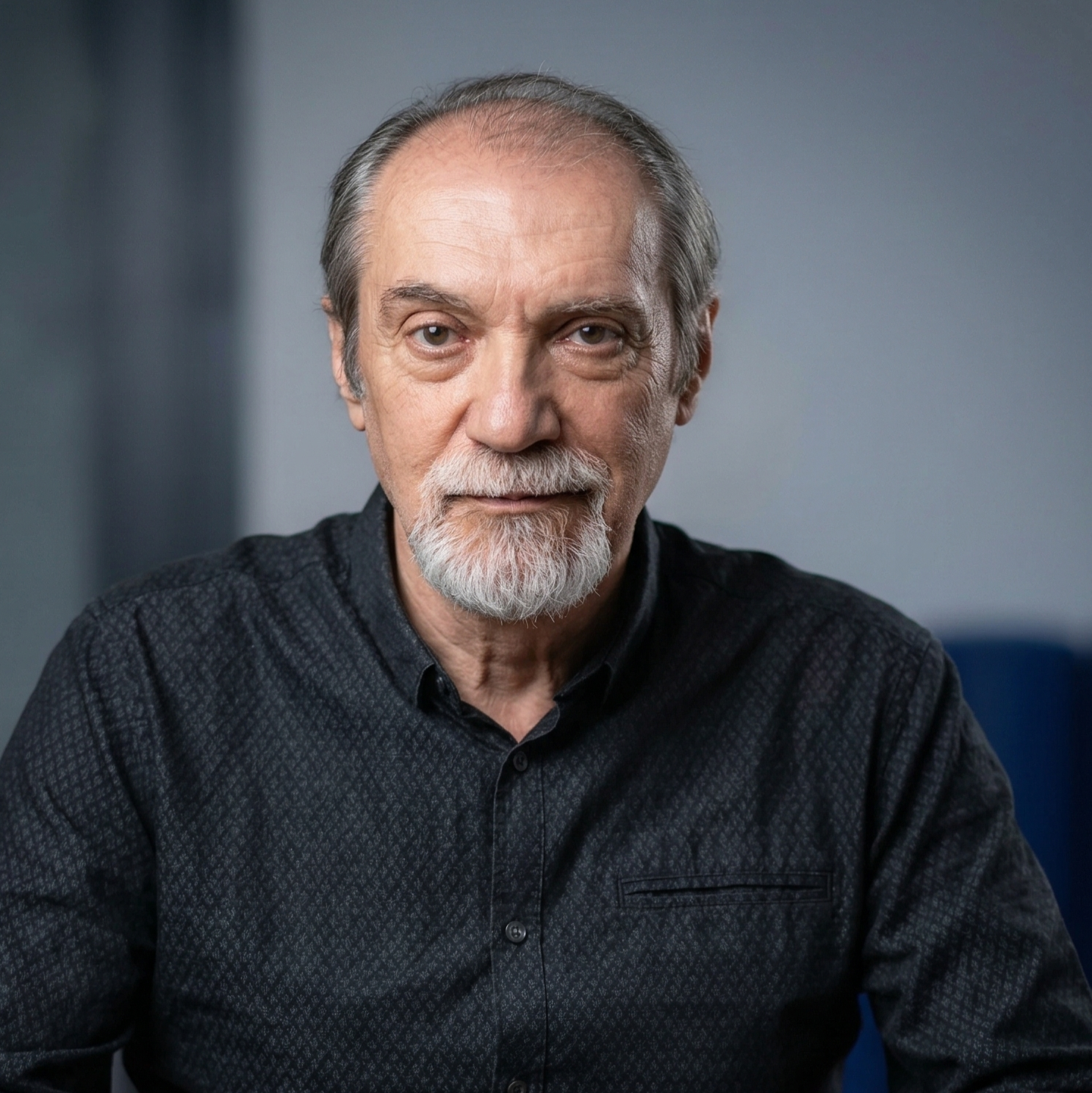
Prof. Darko Kantoci
Topic: “A Novel Multi-Scale Fractal Cognitive Architecture for Artificial Intelligence”
Ph.D. Darko Kantoci, President & CEO of KanDar Enterprises, Inc. Prof. Darko is an industry-recognized technology principal, scientist, and data integration expert with a career that bridges advanced science, engineering, and enterprise technology. With a background in chemistry, physics, mathematics, electronics, and IT, he has led global projects for Fortune 500 companies, such as ExxonMobil and Citibank, where his innovations in financial data systems reduced processing times from weeks to minutes. His work includes 30+ published scientific papers, 8 patents, and keynote appearances at major international conferences. At KanDar, he spearheads the development of SunCore, a next-generation big data management platform already powering secure and large-scale financial reporting at multinational corporations. Under his leadership, KanDar continues to pioneer solutions at the intersection of data science, AI, and enterprise systems.
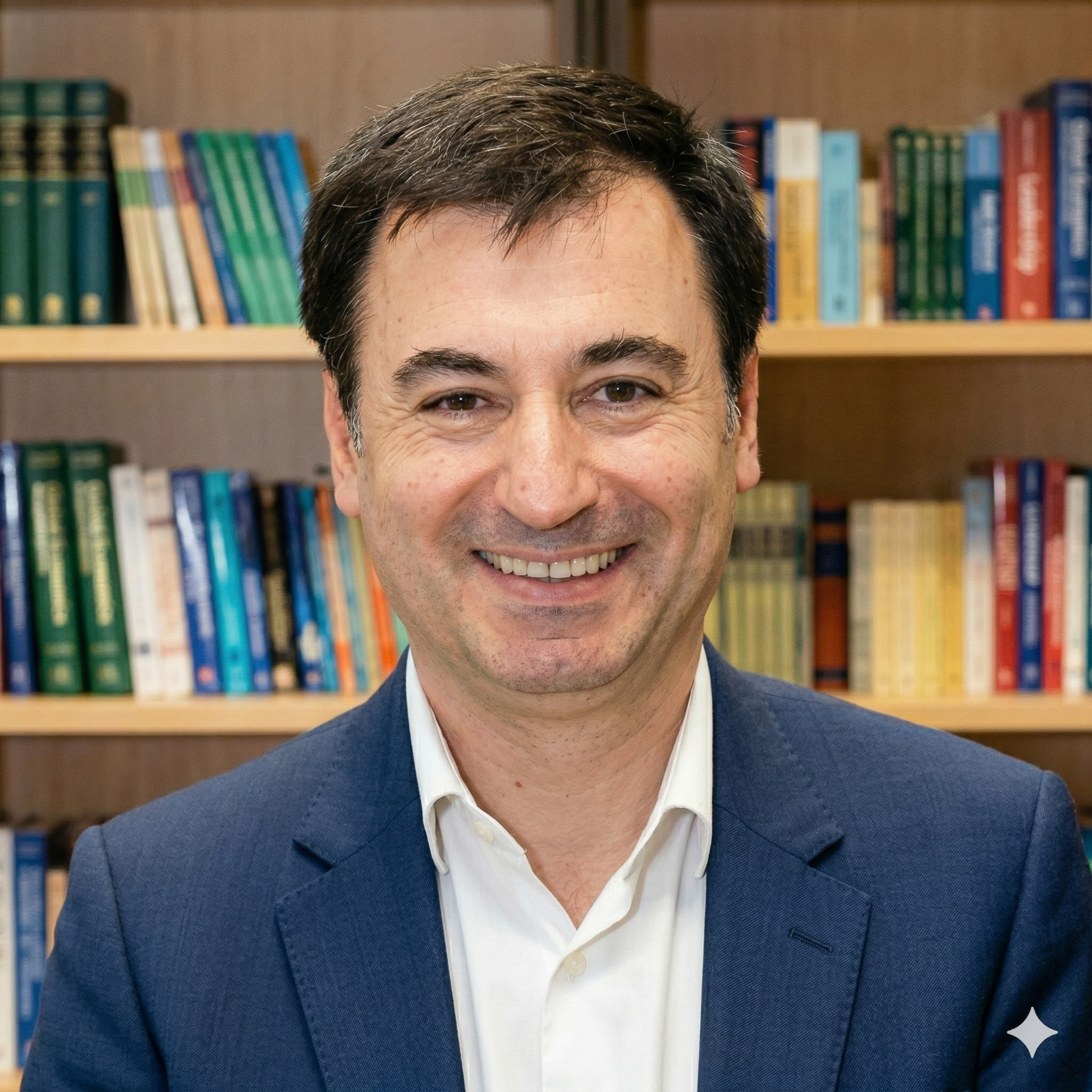
Prof. Arjan Gjonça
Topic: TBD
Prof. Arjan Gjonça is an Associate Professor of Demography at the Department of International Development, London School of Economics and Political Science (LSE). He holds an MSc and PhD in Demography from LSE, where he is also a full member of academic staff. His teaching and research focus on demographic methods, global population health, and development. Prof. Gjonça’s research specializes in health and mortality in developing and transitional societies, with a particular focus on the Balkans and Albania. His work explores health transitions, sex imbalances at birth, gender disparities in health and mortality, and the interaction between development and tradition in shaping demographic behavior. His research has been published in leading international journals, including Population Studies, Population and Development Review, and The Lancet. He has held academic and research positions at institutions such as the Max Planck Institute for Demographic Research, the University of Southampton, the University of Bocconi, and the University of Tirana. Prof. Gjonça has also served as an advisor to international organizations and governments, including the World Bank, UNFPA, UNDP, and several national governments. He currently serves as Chair of the Accreditation Board for Higher Education in Albania and has played a key role in higher education reform in the country.
Honorary committee
Prof Dr Ramiz Zekaj – President of CIT
Prof Dr Ismail Kocayusufoglu – Rector of CIT
Prof Dr Dragan Ljutić, Ph.D – University of Split, Croatia
Prof Dr Mehmet Sarıbıyık – Rector of Sakarya University of Applied Sciences, Turkey
Prof Dr Umberto Fratino – Rector of Politecnico di Bari, Italy
Prof Dr Adalat Muradov – Rector of Azerbaijan State University of Economics (UNEC)
Prof Dr Nicolás Ruiz Reyes – Rector of University of Jaén, Spain
Prof Dr Lotfi Belkacem – Rector of University of Sousse, Tunisia
Prof Dr Fabio Pollice – Rector of University of Salento, Italy
Prof Dr Elvira Fetahu – University of Elbasan, Albania
Prof Dr Dhimitri Bello – Rector of “Fan S. Noli” University, Korca, Albania
Prof Dr Joseph Lee Yu Kuang – Rector of INTI International University, Malaysia
International Scientific Committee
- Prof. Dr. Ismail Kocayusufoglu, Canadian Institute of Technology, Albania
- Prof. Dr. Habib Hamam – University of Moncton, CANADA
- Prof. Dr. Katarzyna Strzala-Osuch, Rector of Powislanski University, Poland
- Prof. Dr. Bekim Fetaji, Mother Teresa University, North Macedonia
- Prof. Dr. Osman Parlaktuna, Eskisehir Osmangazi University, Türkiye
- Prof. Dr. Sokol Abazi, Canadian Institute of Technology, Albania
- Prof. Dr. El-Sayed M. El-Kenawy, Bahrain Polytechnic, Bahrain
- Prof. Dr. Tomasz Bojar-Fijalkowski, Vice-Rector for Science and Quality of Education, Powislanski University, Poland
- Prof. Dr. Pradeep Mishra, Jawaharlal Nehru Krishi Vishwa Vidyalaya, Jabalpur, India
- Prof. Dr. Agus Pramono, University of Sultan Ageng Tirtayasa, Jakarta, Indonesia
- Prof. Dr. Panagiotis Kyratsis, University of Western Macedonia, Kozani, Greece
- Prof. Dr. Odhise Koça, Polytechnic University of Tirana, Albania
- Prof. Dr. Ana I. Polo Peña, University of Granada, Spain
- Prof. Dr. Andres Annuk, Estonian University of Life Sciences, Estonia
- Prof. Dr. Alemayehu Gebremedhin, Norwegian University of Science and Technology, Norway
- Prof. Dr. Hasan Korkut, Marmara University, Türkiye
- Assoc. Prof. Entelë Gavoci, Canadian Institute of Technology, Albania
- Assoc. Prof. Dr. Emre Dandıl, Bilecik Şeyh Edebali University, Türkiye
- Assoc. Prof. Manjola Naço, Canadian Institute of Technology, Albania
- Assoc. Prof. Valentina Ndou, University of Salento, Italy
- Assoc. Prof. Julio Vena Oya, Universidad de Jaén, Spain
- Assoc. Prof. Maxim A. Dulebenets, FAMU-FSU College of Engineering, USA
- Assoc. Prof. Lenka Ližbetinová, Institute of Technology and Business in České Budějovice, Czech Republic
- Assoc. Prof. Nihad Adar, Canadian Institute of Technology, Albania
- Assoc. Prof. Nicola De Filipis, Polytechnic University of Bari, Italy
- Assoc. Prof. Barış Boru, Sakarya Applied Sciences University, Türkiye
- Assoc. Prof. Klodian Dhoska, Polytechnic University of Tirana, Albania
- Assoc. Prof. Oleksandr Bondarenko, SMIEEE, Igor Sikorsky Kyiv Polytechnic Institute, Ukraine
- Assoc. Prof. Arjan Kadareja, Advisor to the President of the Republic of Albania
- Assoc.Prof. Houssem Bouzgarrou, University of Sousse,Tunisia
- Assoc. Prof. Vaso Qano, Canadian Institute of Technology, Albania
- Assoc. Prof. Marcis Prieditis, Riga Technical University, Latvia
- Assoc. Prof. Reis Mulita, Canadian Institute of Technology, Albania
- Assoc. Prof. Mostafa Hajiaghaeikeshteli, Tecnológico de Monterrey, Puebla Campus, Mexico
- Assoc. Prof. Elis Kulla, Fukuoka Institute of Technology, Japan
- Assoc. Prof. Astrit Bardhi, Polytechnic University of Tirana, Albania
- Assoc. Prof. Narasimha Rao Vajjhala, UNYT, Albania
- Assoc. Prof. Ali Almisreb, International University of Sarajevo, Bosnia and Herzegovina
- Assoc. Prof. Fabian Zhilla, Canadian Institute of Technology, Albania
- Assoc. Prof. Abdulsalam Alkholidi, Canadian Institute of Technology, Albania
- Assoc. Prof. Carlene Campbell, University of Wales Trinity Saint David, United Kingdom
- Assoc. Prof. Evjola Spaho, Polytechnic University of Tirana, Albania
- Assoc. Prof. Elena Bebi, Polytechnic University of Tirana, Albania
- Assoc. Prof. Enida Sheme, Polytechnic University of Tirana, Albania
- Assoc. Prof. Alban Rakipi, Polytechnic University of Tirana, Albania
- Assoc. Prof. Dr. Karl Reisinger, Institute of Automotive Engineering, FH Joanneum, Austria
- Assoc. Prof. Mostafa Aboutaleb, Yugra State University, Russia
- Dr. Rim Mosbeh, Sousse University, Tunisia
- Dr. Amir M. Fathollahi-Fard, Université du Québec, Canada
- Dr. Luciana Renata de Oliveira, São Paulo University, Brazil
- Dr. Lisana Berberi, Karlsruhe Institute of Technology (KIT), Germany
- Dr. Maciej Kluz, Vizja University of Economics and Human Sciences, Warsaw, Poland
- Dr. Erjona Deshati, Canadian Institute of Technology, Albania
- Dr. Carlos Roncero, University of Extremadura, Spain
- Dr. Eugen Musta, Canadian Institute of Technology, Albania
- Dr. Euchi Jalel, University of Sousse, Tunisia
- Dr. Reza Moezzi, TULTECH, Estonia
- Dr. Alfred Pjetri, Polytechnic University of Tirana, Albania
- Dr. Enriko Ceko, Canadian Institute of Technology, Albania
- Dr. Aymen Ajina, Sousse University, Tunisia
- Dr. Wassim Ahmed, Canadian Institute of Technology, Albania
- Dr. Savas Okyay, Eskisehir Osmangazi University, Türkiye
- Dr. Blendi Shima, Canadian Institute of Technology, Albania
- Dr. Mohammad Gheibi, Technical University of Liberec, Czech Republic
- Dr. Bledar Kazia, Canadian Institute of Technology, Albania
- Dr. Brisida Sefa, Canadian Institute of Technology, Albania
- Dr. Levon Gevorkov, Catalonia Institute for Energy Research (IREC), Spain
- Dr. Shinji Sakamoto, Kanazawa Institute of Technology, Japan
- Dr. Marwa M. Eid, Delta University for Science and Technology, Egypt
- Dr. Wafa Msallam, Sousse University, Tunisia
- Dr. Maad M. Mijwil, Al-Iraqia University, Iraq
- Dr. Daniel Mădălin Coja, “Dunărea de Jos” University of Galati, Romania
- Dr. Zaid Shhedi, Member, Canadian Institute of Technology, Albania
- Dr. Alfonso García Álvaro, University of Valladolid, Spain
- Dr. Olga Nezerenko, Logistics and Entrepreneurship University of Applied Sciences, Tallinn, Estonia
- Dr. Katarzyna Łyp-Wrońska, AGH University of Science and Technology, Poland
- Dr. Ekaterina Chytilová, Institute of Technology and Business in České Budějovice, Czech Republic
- Dr. Supryia Banerjee, University of the Americas Puebla, Mexico
- Dr. Alda Xhafa, Universitat Autònoma de Barcelona, Spain
- Dr. Farzad Piadeh, University of Hertfordshire, United Kingdom
Organizing commitee
Organizing Committee
Prof. Dr. Ismail Kocayusufoglu, Chairman, CIT, Albania
Assoc. Prof. Dr. Reis Mulita, Member, CIT, Albania
Assoc. Prof. Dr. Klodian Dhoska, Member, UPT, Albania
Assoc. Prof. Dr. Baris Boru, Member, SUBU,Türkiye
Dr. Zaid Shhedi, Member, CIT, Albania
Dr. Brisida Sefa, Member, CIT, Albania
Dr. Erjona Deshati, Member, CIT, Albania
PhD (C.) Erilda Muka, Member, CIT, Albania
PhD (C.) Klea Elmazi, Member, CIT, Albania
Assistants
Odeta Sipri, Rector Office Assistant
Zamira Greva, Administrator Assistant & Protocol Office
Hatixhe Gazidede, Academic Secretary
Elvira Kotorri, Academic Secretary
Denis Çelaj, IT Specialist
Firdeus Dikellari, IT Specialist
Head Of Marketing & PR
Armand Ymeri, Graphic Designer
Kejvin Luga, WebMaster
Agenda
Contact Us
Conference website:
6th ICITTBT 2026 Conference
For any question, please do not hesitate to contact us at: