
Call for Papers
Abstract / Full Paper Submission
Publication Opportunities
Conference Main Topics
Review Process
Paper Template
Book of Abstract
Book of Proccedings
Important Dates
Keynote speakers
Honorary committee
International Scientific Committee
Organizing commitee
Agenda
Conference Fee
Contact Us
Call for Papers
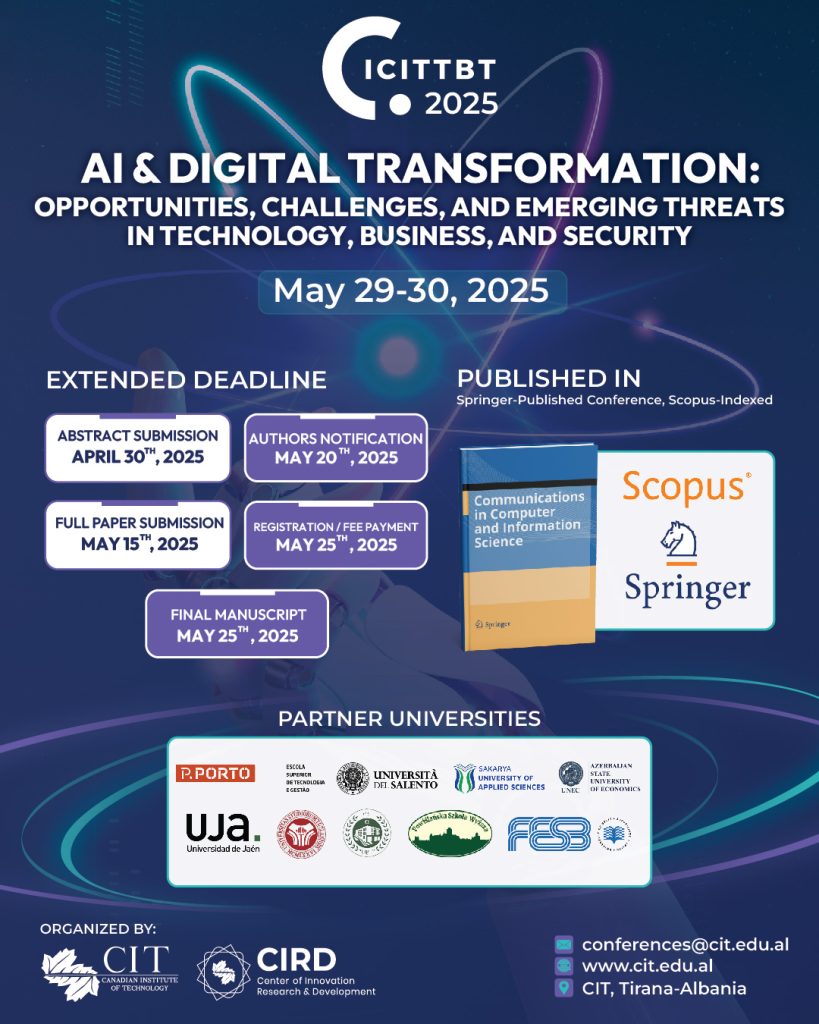
Purpose of the Conference
The 5th International Conference, organized by CIT, aims to explore the dual nature of AI as both a transformative force and a potential risk across diverse sectors. With a focus on fostering dialogue and collaboration, the conference seeks to deepen our understanding of how AI can drive positive change while addressing its associated challenges and risks.
As AI technologies continue to revolutionize industries, enhancing operational efficiency and decision-making, the conference will explore their role in digital transformation and their potential to reshape business, education, science, and employment. At the same time, it will examine the risks that come with AI adoption, including ethical dilemmas, data privacy concerns, and the potential for job displacement.
Through expert discussions and shared experiences, participants will explore best practices for using AI responsibly, develop strategies for mitigating its risks, and collaborate on shaping policies that guide its ethical implementation. This conference provides a platform for participants to exchange ideas, tackle common challenges, and brainstorm innovative solutions that will not only address the current issues but also pave the way for a sustainable and impactful future.
ICITTBT invites participants to join the 5th International Conference organized by CIT to advance the discourse on AI and digital transformation, and work together to ensure that the future of AI serves as a force for positive, inclusive progress.
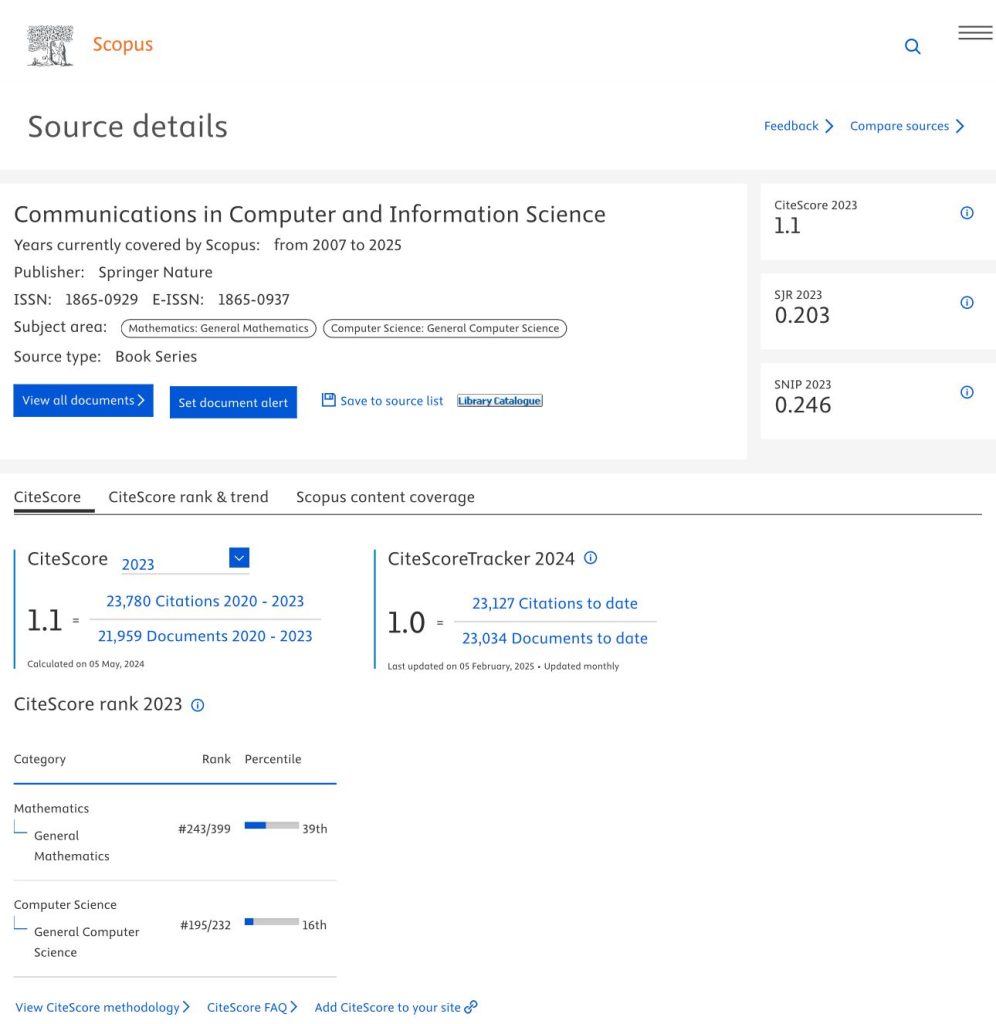
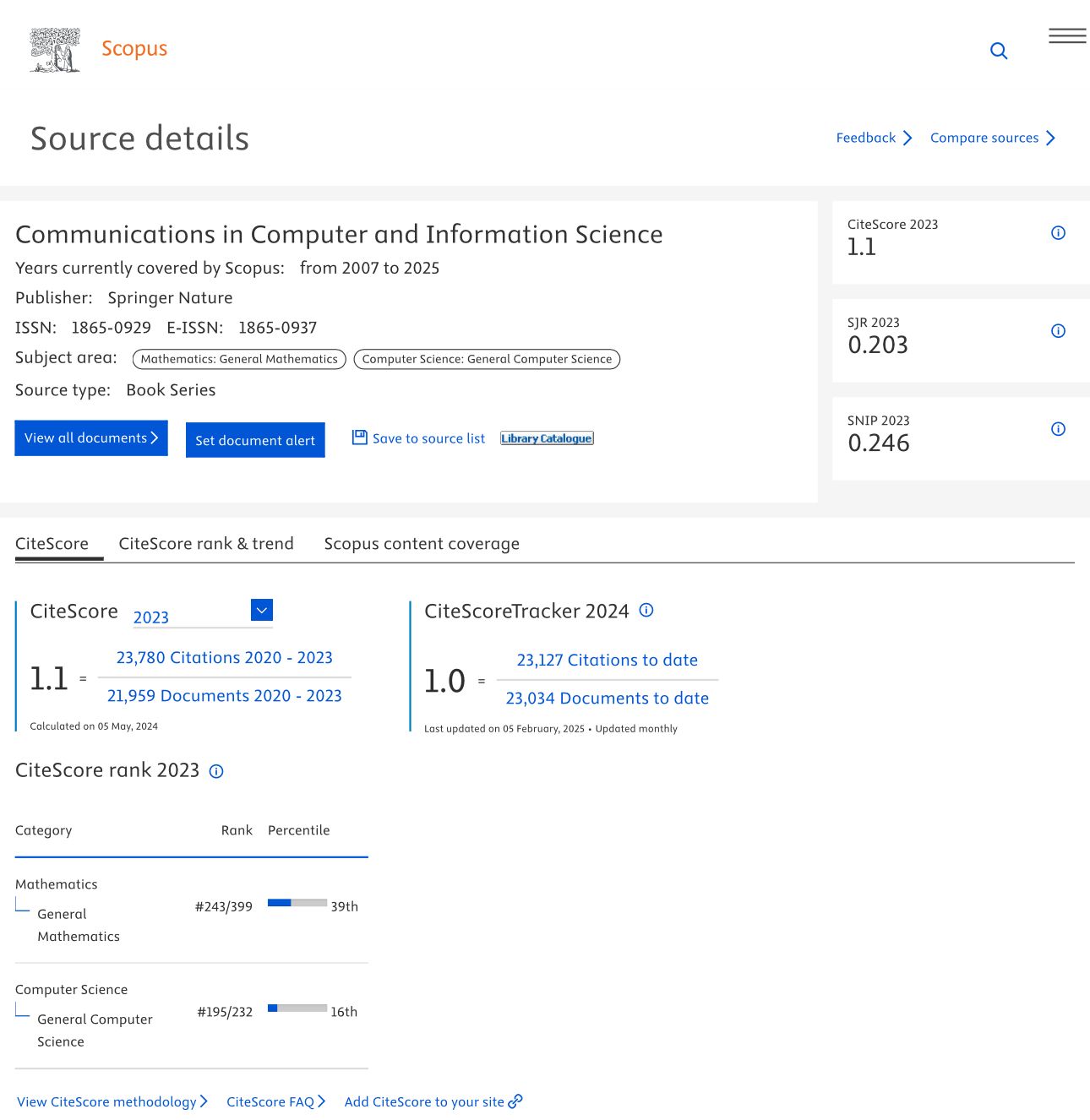
All accepted papers will be included in the conference proceedings of Communications in Computer and Information Science series published by Springer.
Abstract / Full Paper Submission
Email your Abstract / Full Paper to:
[email protected]
Publication Opportunities
All accepted and presented papers will be included in the conference proceedings of Communications in Computer and Information Science series published by Springer.
Conference Main Topics
1. Artificial Intelligence (AI)
· Machine Learning Algorithms
· Deep Learning Algorithms
· AI in Business and Economics
· AI in Education
· AI Ethics and Bias
· AI in Healthcare
· Smart Agriculture and AI Integration
· AI and Big Data in Agricultural Economics
· Forest Science and AI for Ecosystem Management
· Agriculture 4.0: Bridging the Gap Between Traditional and Digital Agriculture
· Ethical and Regulatory Considerations in AI for Agriculture and Environment
· AI and Software Engineering for Agricultural Innovation
· Agricultural Sustainability and Environmental Impact
2. Internet of Things (IoT), Networking, Communication, and Cybersecurity
· IoT Security and Privacy
· IoT Protocols
· IoT Devices and Sensors
· Energy Efficiency in IoT
· IoT Connectivity
· Smart Cities
· Wearable Technologies
· Sustainability in Urban Development
· Wireless Communication
· Blockchain and networking
· Network Architecture
· Mobile Communication
· Social and Economic Impacts of Networking
· Network Security
· Application Security
· Cryptography
· Digital Forensics
· Threat Intelligence
· Cyberbullying
· Children’s Safety in the Cyberspace
3. Data Analytics and Data Science
· Big Data
· Predictive Analytics
· Data Warehousing
· Natural Language Processing
· Computer Vision
· Data Mining
4. Cloud and Mobile Computing:
· Cloud Security
· Cloud Computing Models
· Mobile Application Development
· Cloud Storage
· Serverless Computing
· Data privacy in Cloud Environments
5. Robotics and Automation
- Industrial Robotics
- Power Electronics
- Human-Robot Interaction
- Autonomous Systems
- Robotic Process Automation (RPA)
- Ethics and Governance in Robotics
6. Technology in Applied Sciences
- Virtual Reality Applications
- Augmented Reality in Education/Industry
- XR Interaction Design
- Immersive Technologies
- Renewable Energy
- Materials Engineering
- Digitalization in Mathematical Modeling and Optimization
- Robotics Applications of Calculus
- Physics in Technology: Exploring the Role of Digitalization
- Chemical Processes and Digitalization in Industry
- Biomedical Robotics: Advancing Applications in Biology
- Biotechnological Advancements: Integrating Robotics for Innovation
- Environmental Sciences: Digitalization for Sustainable Solutions
- Robotics-driven Physics Innovations in Technology
7. Digital Economy
· E-commerce and Online Marketplaces
· Fintech Innovations and Digital Banking
· Digital Transformation Strategies
· Digital Entrepreneurship and Startups
· Digital Inclusion and Accessibility
· Digital Marketing and Consumer Behavior
· Data Privacy and Ethical Considerations
8. Management and Business
· Strategic Business Models
· Cross-Industry Collaboration and Partnerships
· Digital Leadership and Change Management
· Supply Chain Resilience in the Digital Era
· Risk Management
· Business Laws and Ethics
9. Finance and Accounting
· Blockchain Technology in Financial Transactions
· Digital Currency and its Accounting Implications
· Robotic Process Automation (RPA) in Accounting
· Automation in Accounting
· Sustainable Finance
· Smart Contracts and Financial Agreements
10. Statistics and Econometrics
· Econometric Analysis of Digital Marketplaces
· Predictive Modeling in the Digital Economy
· Time Series Analysis in Economic Forecasting
· Big Data Analytics and Econometric Modeling
· Quantitative Analysis of Cybersecurity Risks
· Statistical Methods for Detecting Financial Fraud
· Statistical Approaches to Address Bias in AI Algorithms
· Robust Statistical Methods for Handling Uncertainty
11. Economics and Social Sciences
· Digital Inequality and Socioeconomic Disparities:
· Social and Economic Consequences of Cybersecurity Threats
· Ethical Considerations in AI and Robotics
· Social and Cultural Impacts of Digital Transformation
· Digital Literacy and Education for Social Inclusion
· Social Impact Investing and Corporate Social Responsibility
· Behavioral Economics in the Digital AgeMaterials Engineering
Review Process
The review process will be double-blind. Each paper will be reviewed by at least two members of scientific committee. The acceptance decisions will take into account paper novelty, technical depth, elegance, practical or theoretic impact, and presentation.
- Original: the paper explores a new idea, project or issue; discusses existing research with promise of new insight, discusses new research; or presents new ways of considering existing information
- Engaging: presentation format will involve the audience in some way, or has high potential to attract conference attendees by addressing needs of the community
- Significant: the paper raises and discusses issues important to improving the effectiveness and/or sustainability of open education efforts, and its contents can be broadly disseminated and understood
- Quality: claims are supported by sufficient data; claims draw upon relevant literature; and limitations are described honestly
- Relevant: the paper addresses one or more of the themes of the conference
Paper Template
Book of Abstract
Book of Proccedings
Proceedings of International Conference – Part of the book series: Communications in Computer and Information Science (CCIS, volume 2670)
| Volume 1 | Link to the volume 1 |
| Volume 2 | Link to the volume 2 |
Important Dates
| SUBJECT | DEADLINES |
|---|---|
| Deadline for Abstract Submission* | 30th April, 2025 |
| Deadline for Full Paper Submission | 15th May, 2025 |
| Authors Notification | 20th May, 2025 |
| Author Registration | 26th May, 2025 |
| Final Manuscript | 25th May, 2025 |
* The form of the abstract is in the “Paper Template” Section.
Keynote speakers
Prof. Dr. Gastone Castellani
Topic: “Generative AI in Medicine with focus on synthetic data generation”
Prof. Castellani is laureated in Biology and Physics and has a PhD in Physics. He is full Professor at the Bologna University in Applied Physics-Biophysics and is the Director of the Galvani center for Bioinformatics, Biophysics and Biocomplextity. He holds, from the 2000, the position of Associate Professor (Research) at Brown University, Providence RI USA where is doing research within the group of Prof Leon N Cooper on machine learning, neural networks and big data analytics of gene expression. He is coauthor of more than 200 publications on international peer-reviewed journal, and, in total more than 200 printed contributions (9000 citations and H index 51). He has been awarded two International prizes: (Chaos and Complexity prize Blois France 1993, Vice President award Brown University 2003) for innovative research in the field of complex biological systems. He is referee for several journals such as PNAS, Molecular Bio-system, Physical Review and Bioinformatics. He is one of the founders of the Italian Society for Systems Biology (SysBioHealth). Recently He obtained a 3-year project from the Programa ciência sem fronteiras – bolsas no país modalidade pesquisador visitante especial titled: SYSAGEOMICS Systems Biology of Aging and Age-related diseases by integration of Multiscale Experimental and Computational Methods. He has obtained also a special grant from Brown University for a collaboration with Brasilian Universities of Belo Horizonte on the measurements of circulating nucleic acids. The current research topics are on Machine Learning Big Data and Artificial Intelligence applied to BioMedical data. Statistical Interpretation of AI methods. He is involved in several EU projects (GenoMed4All, SYNTHEMA, METASTRA, SYNTHIA).

Assoc. Prof. Julio Vena Oya
Topic: “Is AI enough to build consumer confidence? An experiment with AI Instagramer, chat GPT, and recommendations from the community”
Prof. Julio Vena Oya is an Associate Professor (Research) at the University of Jaén, Spain. He was graduated in Business Administration, then he had a Master in Marketing and Consumer Behavior from the University of Granada. He earned his PhD in Economic Sciences from the University of Granada as well. Prof Vena-Oya has authored and published articles in leading economics journals and has frequently presented at scientific conferences. He is a scholar affiliated with the University of Jaén, Spain. His research focuses on tourism, particularly cultural tourism, sustainable destination management, and entrepreneurship in tourism sectors. He has contributed to various studies on tourist spending, post-COVID economic recovery, and sustainable tourism financing. His work has been published in journals like Tourism Management Perspectives and Current Issues in Tourism, with notable collaborations on projects related to cultural micro-destinations and environmental sustainability in tourism
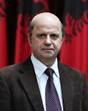
Assoc. Prof. Arjan Kadareja
Topic: “Economy, Business and Artificial Intelligence”.
Prof. Kadareja is an Associate Professor and an experienced Financial and Economics University Professor as well as a research professional aiming to apply his knowledge and expertise to teaching and financial research. Since July 2022, Prof Kadareja has served as an adviser to the President of the Republic of Albania and as an external instructor at the University of New York Tirana and St. Clair College in Windsor, Canada. His selected achievements are:• Advisor to the President of the Republic of Albania• Voting Member of the Bank of Albania Supervisory Board• Financial Research Consultant at European Central Bank• PhD in International Economics • CFA® charterholder• Prof Kadareja has authored and published articles in leading economics and finance journals and has frequently presented at scientific conferences. He has in-depth knowledge and expertise in macroeconomics, finance and central banks, as well as in issues of economic and financial integration. His research areas are: The impact of the Euro on Equity Markets, Stale Information, Shocks and Volatility, Measuring Comovements by Regression Quantiles. The Swiss Franc and the Euro, MARMOTTE Un Modele Multinational De 17 Pays Industrialises.

Prof. R. Ian Angell
Topic: ” Enabling startups in the AI and digital space – new business models, stronger support and a caring environment”.
Prof. R. Ian Angell, is the Managing Director of Embark, TWU’s Venture Incubator, an incubator for tech and non-tech businesses located in the Greater Vancouver area of Canada. In addition to his role as MD of Embark, Ian is the CEO-in-Residence and a Professor of Strategy in Trinity Western University’s School of Business. Ian’s mandate is to improve the integration between the University and the entrepreneurial and corporate community. Prof. Angell has 40 years of varied and balanced experience across corporate executive roles, management consulting roles, and as an entrepreneur. His industry experience spans agriculture, resources, apparel, creative/film, and corporate finance. Embark is currently working with three AI and a few technology (Saas and Hardware) companies to help then launch and grow. Prof. Angell has a unique perspective as a former entrepreneur regarding what it takes to be successful in AI and technology in the current global uncertainty.
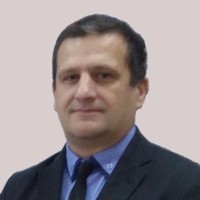
Martin Necpal, – Topic ” Digital Technology and Artificial Intelligence in CAM, CNC Machining, Manufacturing, and Simulation “.
Professor Necpal is a lecturer at the Slovak University of Technology in Bratislava, Faculty of Materials Science and Technology in Trnava. He earned his Ing. degree in Engineering Production Technology in 2004 and his PhD in Materials Science and Technology in 2010, both from the same institution. Since 2011, he has been working at the Institute of Production Technology, where his teaching and research focus on the modeling and simulation of manufacturing processes, particularly using the finite element method (FEM). His primary expertise lies in machining process simulation, such as chip formation and tool–workpiece interaction, as well as metal forming technologies, including tube drawing. He has also integrated artificial intelligence and digital tools. Dr. Necpal is actively involved in research and industrial projects, particularly at the 5-axis machining research center of the Institute of Manufacturing Technology. There, he works with a LASERTEC 80 Shape laser ablation machine, focusing on precision laser machining, surface structuring, and advanced process development. He has participated in the CEEPUS mobility program, delivering lectures at several universities across Central and Eastern Europe, including the University of Novi Sad (Serbia), Transilvania University of Brașov (Romania), Technical University of Sofia (Bulgaria), University of Tuzla and University of Bihać (Bosnia and Herzegovina), and Jan Evangelista Purkyně University in Ústí nad Labem (Czech Republic). He is also a partner in the Erasmus+ mobility program with the University of Montenegro, Faculty of Mechanical Engineering, supporting academic exchange and collaborative research. He is the co-author of several educational materials on the simulation of forming processes and has published over 50 papers in peer-reviewed journals and conference proceedings. His work has been presented at scientific events in Europe, Japan, and Malaysia. Dr. Necpal is a member of the Czechoslovak Association for Crystal Growth and the Slovak Metal Science Society.
Honorary committee
Prof Dr Ramiz Zekaj – President of CIT
Prof Dr Ismail Kocayusufoglu – Rector of CIT
Prof Dr Merita Xhumari – Chair Woman of the Board of Administration
Prof Dr Dragan Ljutić – Rector of FESB
Prof Carlos Ramos – Pro-President of P.Porto
Prof Dr Fatbardh Sallaku – Rector of UBT
Prof Dr Fabio Pollice – Rector of Salento
Prof Dr Krystyna Strzala – Rector of Powislanski
Prof Dr Nicolás Ruiz Reyes. University of Jaén
Prof Dr Adalat Muradov Rector of UNEC
Prof Dr Mehmet SARIBIYIK Rector of Sakarya University SUBU
Prof Dr Nermina Hadžigrahić Rector of Tuzla University
International Scientific Committee
Prof. Dr. Ismail Kocayusufoglu, Canadian Institute of Technology, Albania
Prof. Dr. Merita Xhumari, Canadian Institute of Technology, Albania
Prof. Dr. Manuela Mece, Canadian Institute of Technology, Albania
Prof. Dr. Sokol Abazi, Canadian Institute of Technology, Albania
Prof. Dr. Hasan Korkut, Marmara University, Turkiye
Prof. Dr. Bekim Fetaji, Mother Teresa University, North Macedonia
Prof. Dr. Osman Parlaktuna, Eskisehir Osmangazi University, Turkiye
Prof. Dr. El-Sayed M. El-Kenawy, Bahrain Polytechnic, Bahrein
Prof. Dr. Katarzyna Strzala-Osuch: Rector of Powislanski University, Poland
Prof. Dr. Tomasz Bojar-Fijalkowski: Vice-Rector for Science and Quality of Education of Powislanski University, Poland
Prof. Dr. Pradeep Mishra, Jawaharlal Nehru Krishi Vishwa Vidyalaya, Jabalpur, India
Prof. Dr. Agus Pramono, University of Sultan Ageng Tirtayasa, Jakarta, Indonesia
Prof. Dr. Özcan Köysüren, Ankara University, Turkey
Prof. Dr. Panagiotis Kyratsis, University of Western Macedonia, Kozani, Greece
Prof. Dr. Odhise Koça, Polytechnic University of Tirana, Albania
Prof. Dr. Ana I. Polo Peña, Professor at the University of Granada, Spain
Prof. Dr. Andres Annuk, Estonian University of Life Sciences, Estonia
Prof. Dr. Alemayehu Gebremedhin, Norwegian University of Science and Technology, Norway
Assoc. Prof Vaso Qano, Canadian Institute of Technology, Albania
Assoc. Prof. Marcis Prieditis, Riga Technical University, Latvia
Assoc. Prof. Arjan Kadareja, Advisor to the President of Republic of Albania
Assoc. Prof. Nicola de Filipis, Polytechnic University of Bari, Italy
Assoc. Prof. Valentina Ndou, University of Salento, Italy
Assoc. Prof. Julio Vena Oya, Universidad de Jaén, Spain
Assoc. Prof. Maxim A. Dulebenets, FAMU-FSU College of Engineering, USA
Assoc. Prof. Lenka Ližbetinová, Institute of Technology and Business in České Budějovice, Czech Republic
Assoc. Prof. Entelë Gavoci, Canadian Institute of Technology, Albania
Assoc. Prof. Nihad Adar, Canadian Institute of Technology, Albania
Assoc. Prof. Reis Mulita, Canadian Institute of Technology, Albania
Assoc. Prof. Bariş BORU, Sakarya Applied Science University, Turkey
Assoc. Prof. Mostafa Hajiaghaeikeshteli, School of Engineering and Science, Tecnológico de Monterrey, Puebla Campus, Mexico
Assoc. Prof. Elis Kulla, Fukuoka Institute of Technology, Japan
Assoc. Prof. Oleksandr Bondarenko, SMIEEE, Igor Sikorsky Kyiv Polytechnic Institute, Ukraine
Assoc. Prof. Klodian Dhoska, Polytechnic University of Tirana, Albania
Assoc. Prof. Astrit Bardhi, Polytechnic University of Tirana, Albania
Assoc. Prof. Narasimha Rao Vajjhala, UNYT, Albania
Assoc. Prof. Ali Almisreb, International University of Sarajevo, BiH
Assoc. Prof. Fabian Zhilla, Canadian Institute of Technology, Albania
Assoc. Prof. Abdulsalam Alkholidi, Canadian Institute of Technology, Albania
Assoc. Prof. Carlene Campbell, University of Wales Trinity Saint David, United Kingdom
Assoc. Prof. Evjola Spaho, Polytechnic University of Tirana, Albania
Assoc. Prof. Elena Bebi, Polytechnic University of Tirana, Albania
Assoc. Prof. Enida Sheme, Polytechnic University of Tirana, Albania
Assoc. Prof. Alban Rakipi, Polytechnic University of Tirana, Albania
Assoc. Prof. Dr. Karl Reisinger, Institute of Automotive Engineering, FH Joanneum, Austria
Dr. Amir M. Fathollahi-Fard, Université du Québec, Canada
Dr. Luciana Renata de Oliveira, São Paulo University, Brazil
Dr. Lisana Berberi, Karlsruhe Institute of Technology (KIT), Germany
Dr. Maciej Kluz, Vizja, University of Economics and Human Sciences, Warsaw, Poland
Dr. Carlos Roncero, University of Extremadura, Spain
Dr. Eugen Musta, Canadian Institute of Technology, Albania
Dr. Reza Moezzi, TULTECH, Estonia
Dr. Alfred Pjetri, Polytechnic University of Tirana, Albania
Dr. Enriko Ceko, Canadian Institute of Technology, Albania
Dr. Wassim Ahmed, Canmadian Institute of Technology, Albania
Dr. Savas Okyay, Eskisehir Osmangazi University, Turkiye
Dr. Blendi Shima, Canadian Institute of Technology, Albania
Dr. Alfons Harizaj, Canadian Institute of Technology, Albania
Dr. Mohammad Gheibi, Technical University of Liberec, Czech Republic
Dr. Bledar Kazia, Canadian Institute of Technology, Albania
Dr. Brisida Sefa, Canadian Institute of Technology, Albania
Dr. Levon Gevorkov, Catalonia Institute for Energy Research (IREC), Spain
Dr. Mostafa Aboutaleb, South Ural State University, Russia
Dr. Shinji Sakamoto, Kanazawa Institute of Technology, Japan
Dr. Marwa M. Eid, Delta University for Science and Technology, Egypt
Dr. Maad M. Mijwil, Al-Iraqia University, Iraq
Dr. Erjona Deshati, Canadian Institute of Technology, Albania
Dr. Zaid Shhedi, Member, Canadian Institute of Technology, Albania
Dr. Ali Shengjergji, Member, Canadian Institute of Technology, Albania
Dr. Alfonso García Álvaro, University of Valladolid, Spain
Dr. Olga Nezerenko, Logistics, Enterpreneuship University of Applied Sciences, Tallinn, Estonia.
Dr. Katarzyna Łyp-Wrońska, AGH University of Science and Technology, Poland
Dr. Ekaterina Chytilová , Institute of Technology and Business in České Budějovice, Czech Republic
Dr. Supryia Banerjee, University of Americas Puebla, Mexico
Dr. Alda Xhafa, Universitat Autònoma de Barcelona, Spain
Dr. Farzad Piadeh, University of Hertfordshire, United Kingdom.
Organizing commitee
Organizing Committee
Prof. Dr. Ismail Kocayusufoglu, Chair, Canadian Institute of Technology, Albania
Prof. Dr. Manuela Mece, Member, Canadian Institute of Technology, Albania
Assoc. Prof. Dr. Entela Gavoci, Canadian Institute of Technology, Albania
Assoc. Prof. Dr. Klodian Dhoska, Polytechnic University of Tirana, Albana
Assoc. Prof. Bariş BORU, Sakarya Applied Science University, Turkey
Dr. Wassim Ahmad, Member, Canadian Institute of Technology, Albania
Dr. Bledar Komina, Member, Canadian Institute of Technology, Albania
Dr. Zaid Shehdi, Member, Canadian Institute of Technology, Albania
Dr. Enriko Ceko, Member, Canadian Institute of Technology, Albania
Dr. Ali Shengjergji, Member, Canadian Institute of Technology, Albania
Dr. Brisida Sefa, Member, Canadian Institute of Technology, Albania
MSc. Ubejd Osmani, Member, Canadian Institute of Technology, Albania
MSc. Kevin Bica, Member, Canadian Institute of Technology, Albania
MSc. Zejneb Osmani, Member, Canadian Institute of Technology, Albania
Assistants staff
Zamira Greva
Odeta Sipri
Jona Shtini
Renilda Lleshi
Hatixhe Gazidede
Elvira Kotorri
Ergi Bogdani
Kejvin Luga
Agenda
Conference Fee
| CONFERENCE REGISTRATION TYPES | ||||
| Description | Participation Benefits | Details | Fees (Euros) | |
| For participants that will present and publish the paper in Springer Proceedings Book – Scopus Indexed | Springer Proceedings Book Paper Author | Springer Proceedings Book Scopus-indexed (Online Publication); Certificates of Presentation for the presenter and other authors; Conference Materials; Attendee ID Badge; Network Lunch; Cocktail; Gala Dinner; | Springer Proceedings Book – Scopus-indexed info: CCIS Series: Indexed by: SCOPUS (Citescore = 1.1), SCImago, DBLP, EI Compendex, and INSPEC | €300 |
| For participants that request only the Book of Abstracts | Abstract Author | CIT Online Book of Abstracts; Certificates of Presentation for the presenter and other author; Conference Materials; Attendee ID Badge; Cocktail; Gala Dinner; | €70 | |
| Info. | Additional Author | The accompanying person fee (if they participate in the event) | €30 | |
| For Non-Authors | Non-Author | Participation and Network; Conference Materials; Attendee ID Badge; Cocktail | €20 | |
Bank Details:
Name: C.I.T SHPK
IBAN NO: AL42203100181701001000226190
SWIFT CODE: AAISALTR
Contact Us
Conference website:
For any question, please do not hesitate to contact us at: